sports
Jun 16, 2026
The Knicks Turned Suffering Into Currency
The Knicks did more than win a title. They gave New York a return on fifty-three years of belief.
Before the Garden, before the parade, before the championship hats sold like proof of life, there is the cage on West Fourth. A rectangle of asphalt and chain-link in lower Manhattan where basketball feels less like a sport than a language the city invented for itself. Some will argue New York is not the spiritual home of basketball, and they can have the argument. They can point to Indiana gyms, North Carolina tobacco roads, Kentucky blue blood, L.A. glamour, Chicago mythology, Boston banners. Fine. But stand by the cage long enough and watch the city pass through one game. Different backgrounds, different origins, different futures, different names, different gods, different rent problems, different versions of ambition. For a few possessions, basketball becomes the stabilizer. The common denominator. The cleanest currency in a city that prices everything.
That is what New York has always understood about the game. Basketball is not only something played here. It is exchanged here. Respect, embarrassment, status, memory, confidence, style, pain, neighborhood, ego, survival. You can see it on cracked courts before you ever see it under the lights at Madison Square Garden. The ball goes up, and the city reduces itself to something beautifully simple: can you play, can you hold your own, can you earn the next possession?
That is why a Knicks championship was never going to stay inside the Knicks. It was always going to spill across the city, because the Knicks are the professional face of a basketball culture that existed before them, beneath them, and sometimes in spite of them. New York is known for money, fashion, food, theatre, finance, noise, ambition, and every human contradiction stacked vertically into rent-controlled chaos. But basketball has always given the city one of its purest forms of translation. Put ten strangers on a court and the differences do not disappear, but they do become playable. The game gives everyone a role, a rhythm, a test.
So when the Knicks finally won, it did not feel like a franchise simply ending a drought. It felt like the city’s basketball currency had finally cleared at the highest level. The cage, the parks, the schoolyards, the old heads, the kids with too much handle and no jumper, the fathers who still swear the seventies were better, the borough arguments, the Garden ghosts — all of it got pulled into the same receipt.
There are cities that celebrate championships, and then there is New York, which metabolizes them. It does not receive joy cleanly. It converts it into noise, merchandise, headlines, sidewalk sermons, bad behavior, good behavior, civic mythology, traffic, commerce, arguments, and one million people who suddenly remember they always believed, even if the receipts from the last half-century suggest belief occasionally looked a lot like yelling at the television in sweatpants.
The Knicks won the title, and New York did what New York does when something impossible finally becomes official.
It cashed the whole city.
That is the thing about a Knicks championship. It was never going to belong only to basketball. This was not Denver winning with a generational centre, or Golden State extending a dynasty, or San Antonio turning the future into a seven-foot-five laboratory. This was the Knicks. The New York Knicks. The organization that has spent most of modern NBA history functioning as a public trust for disappointment. The team that made patience feel like a character flaw. The team that turned Madison Square Garden into the most expensive theatre of emotional self-harm in American sports. The team that made “next year” sound less like optimism and more like a family curse passed down through generations.
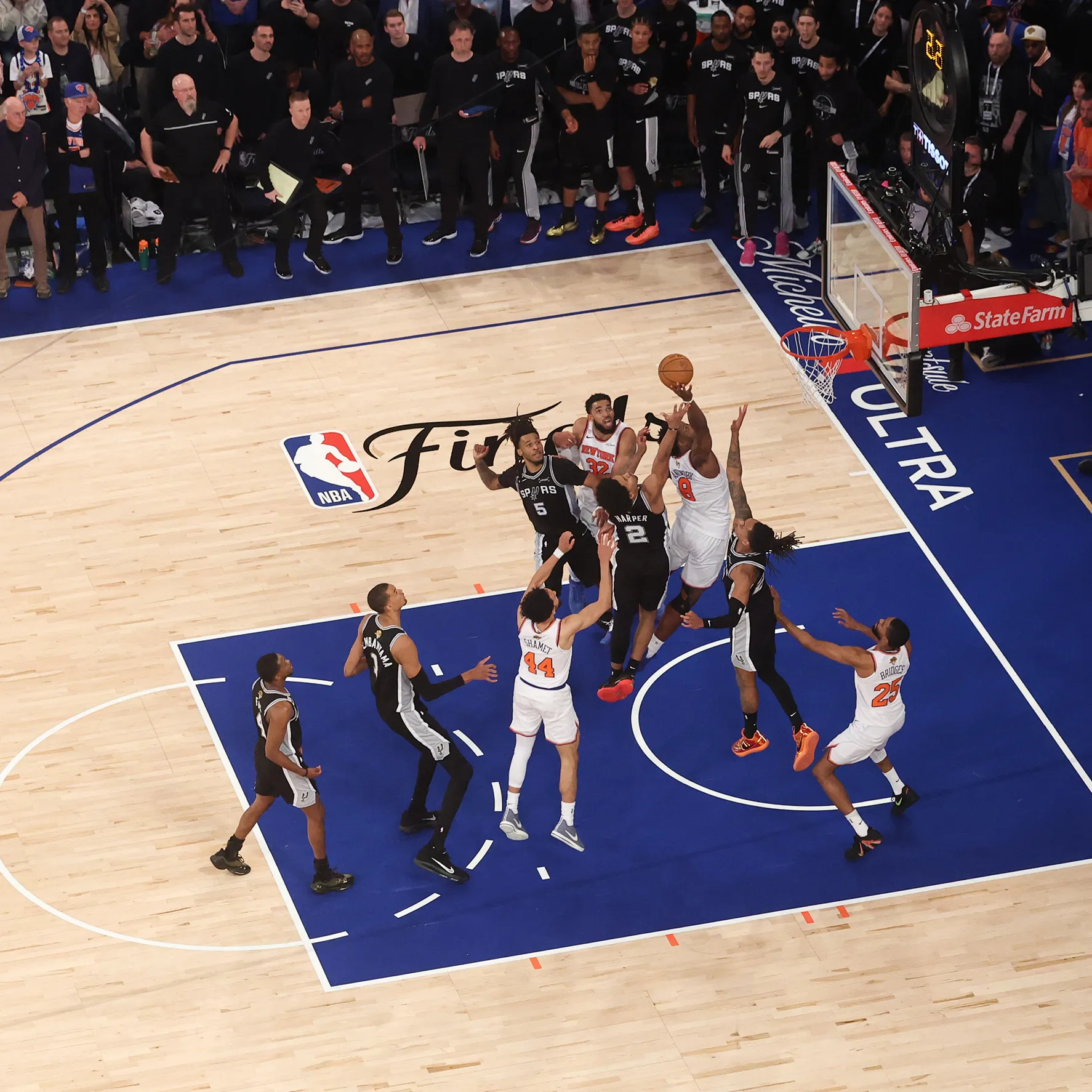
And then Jalen Brunson dropped 45, the final horn went, and all of that suffering had to be repriced.
That is why this one hits differently. A title after two or three years of contention is a championship. A title after 53 years is a market event. It changes the value of every bad memory attached to the franchise. The terrible contracts, the false saviors, the wasted draft nights, the tabloid front pages, the empty promises, the overpaid veterans, the weird press conferences, the early exits, the celebrity courtside grimaces, the annual delusion machine that restarted every October because New York is constitutionally incapable of humility. All of it suddenly became part of the asset.
The suffering did not disappear. It appreciated.
This is the strange mathematics of sports pain. Losing has no value while it is happening. It is just losing. It is wasted time. It is bad basketball. It is your friends texting “lol Knicks” before you can even open the box score. It is your father telling you about Willis Reed like he personally served in the Battle of Madison Square Garden. It is Spike Lee aging in real time on the baseline. It is every bright-orange offseason headline turning to ash by February. It is the Garden crowd trying to convince itself that a seven-seed with vibes might be the start of something. It is the city’s enormous appetite for belief meeting an organization that kept feeding it crumbs.
But when the title finally comes, the losing becomes backstory. The pain becomes equity. Every year that made the fanbase look foolish becomes one more layer of meaning. The long drought becomes the reason the party is bigger, the parade louder, the merchandise hotter, the tears more embarrassing, the hugs longer, the middle-aged men more willing to admit that a basketball team has been quietly managing their emotional weather since childhood.
New York did not just win the NBA title. New York liquidated 53 years of delusion.
This is why the Knicks are a different kind of championship property. The Lakers win and it looks expensive. The Celtics win and it looks historical. The Warriors win and it looks engineered. The Heat win and it looks institutional. The Spurs win and it looks inevitable, like someone in the front office solved basketball during lunch. The Knicks win and it looks like a city-wide psychological event. It looks like the market discovering a distressed asset was sitting on cultural oil the whole time.
The Knicks were never small, even when they were bad. That was the problem and the promise. Most losing teams get ignored. The Knicks got studied. Mocked. Tracked. Monetized. They were a failure product with premium distribution. National television still wanted them. Celebrities still came. The building still mattered. The brand still sold. The city still cared. The Knicks were a contradiction: irrelevant in the standings, central in the imagination. For decades, they were proof that in New York, attention and competence are allowed to live separate lives.
Then Brunson arrived and made the whole thing serious again.
Not loud serious. Not fake-superteam serious. Not press-conference serious. Real serious. Footwork, craft, pressure, fourth-quarter violence, the strange calm of a player who seems to understand that New York does not need saving as much as it needs organizing. Brunson became the first Knicks star in a generation who did not seem swallowed by the city’s appetite. He did not perform importance. He imposed it. He turned the Garden from a museum of old ghosts into a working building again.
There is something deeply funny and deeply right about the Knicks ending 53 years of wandering behind a player who looks, at first glance, like the league should have found a reason to doubt him forever. Too small. Too measured. Too grounded. Too familiar. Not quite the poster. Not quite the prophecy. But New York, when it is being honest with itself, has always loved the worker more than the prince. It loves the guy who knows the train is delayed and shows up anyway. It loves competence that carries a grudge. Brunson gave the city that. He gave the Knicks a centre of gravity. He made the irrational people sound reasonable for once.
That might be his greatest achievement.
He made Knicks belief look disciplined.
The city had been waiting for permission. That is what the final buzzer really gave it. Permission to release every old argument at once. Permission to turn into the version of itself everyone else finds exhausting and secretly wants to watch. Permission to buy the hat, block the street, call the father, text the ex, scream at strangers, kiss someone under a traffic light, refresh Fanatics, repost the Brunson photo, overstate the dynasty, declare the boroughs unified, and pretend the last half-century was all part of the plan.
This is where sports becomes commerce almost instantly. The emotional release turns into a cart. The cart turns into a receipt. The receipt turns into proof. Championship shirts are not clothing in that moment. They are timestamped evidence. They say: I was here when the debt cleared. I paid to remember it. I paid to make the invisible thing visible. In a normal market, merchandise is merchandise. After a Knicks title, merchandise becomes civic documentation.
That is the belief-to-commerce pipeline. It is crude, beautiful, and undefeated.
A championship does not only change how fans feel. It changes what their feeling is worth. Knicks fandom had always been expensive emotionally, but for most of the last 53 years it was a luxury good with no utility. You paid in attention, hope, and humiliation. You received vibes, nostalgia, and occasional second-round panic. The title changed the exchange rate. Suddenly every old ticket stub, jersey, argument, and doomed prediction carried the glow of eventual correctness. The fan who never left gets to mark the whole position up.
That is what long-suffering fanbases understand better than anyone. They are not simply rooting. They are holding a position with no clean exit. You do not sell Knicks fandom in a bear market. You inherit it, curse it, dress it up as personality, and hope one day the thing becomes valuable enough to justify what it cost you. Most people never get the settlement. Knicks fans did.
This is why the celebration looked less like surprise and more like collection.
New York had been waiting to collect.
The city is built for this kind of settlement because New York’s relationship with sports has always been financial even when it is emotional. Everything is priced. Everything is negotiated. Everything is leveraged. Hope has rent. Loyalty has tax. Failure has resale value if the story is good enough. The Knicks were the ultimate New York instrument: volatile, overpriced, irrationally loved, historically underperforming, and somehow still impossible to ignore.
Now they are champions, which means the market has to deal with something more dangerous than Knicks despair.
Knicks confidence.
That is the next tax. Winning after decades of failure creates a different kind of problem. Once belief pays, belief gets expensive. The title does not make the fanbase rational. It gives irrationality a banner. Every future market changes. Every October take gets louder. Every free agent rumor gets oxygen. Every Brunson fourth quarter becomes scripture. The public money comes in warmer. The brand expands. The jokes stop working for a while. The Knicks no longer carry only the dysfunction tax. They carry the champion premium.
That is where the operator layer gets interesting. A team like the Knicks winning does not just change history. It changes behavior. Futures shorten. Casuals return. Dormant fans reactivate. Merchandise spikes. Media volume explodes. Every game next season carries championship residue. A franchise that used to attract emotional betting through pain now attracts emotional betting through proof. The market does not just price the team. It prices the story attached to the team.
And the Knicks now have the most valuable story in basketball.
Not the cleanest story. Not the most efficient. Not the most elegant. The most valuable. Because nothing sells like the end of a drought in a city that already thought it was the centre of the world. The Knicks turned suffering into currency because New York had spent 53 years minting it. Every bad season became supply. Every punchline became scarcity. Every loyal fan became a witness. When the win finally came, demand was not created. It was released.
That is the difference.
Some championships build a market. This one unlocked one.
There will be time for the sober analysis later. Cap sheets. Matchups. Repeat odds. Brunson’s place in the league. The Spurs’ future. The Finals MVP résumé. Whether this is the beginning of a window or the perfect peak of a team that caught the moment clean. All of that matters, and all of it will arrive soon enough, because sports media cannot let joy stand untouched for more than 48 hours before asking if it is sustainable.
But the first reading should be emotional, because the event itself was emotional before it was analytical.
The Knicks won.
That sentence is ridiculous and simple and somehow still large enough to hold 1973, 1999, the lost years, the bad years, the almost years, the Garden, the fathers, the sons, the daughters, the bars, the boroughs, the celebrities, the diehards, the bandwagoners, the people who swore they were done, the people who never had the discipline to be done, the people who watched Game 5 alone because sports grief teaches strange habits, and the people who immediately needed to be in the street because joy that delayed cannot be kept indoors.
The Knicks won, and the city got to be young again for a night.
That is the part the market cannot fully price. It can price the odds, the tickets, the jerseys, the sponsorships, the secondary market, the media rights, the franchise valuation, the parade economy, the future handle, the championship premium. It can price almost everything around the feeling.
But it cannot fully price the feeling.
It cannot price a 53-year wait breaking open at once. It cannot price a city that has turned cynicism into an art form suddenly allowing itself to believe without irony. It cannot price the moment a long position becomes a winning ticket and the fan holding it realizes the years were not refunded, but they were finally acknowledged.
That is what the Knicks cashed.
Not just the title.
The whole position.
Fifty-three years of belief, marked to market at last.
Ready to manage your money smarter?
Start your journey to smarter spending and better saving — it only takes 2 minutes.